Certificates of Analysis: Matching a Report to a Research Batch
Research-use-only notice: the materials discussed here are for in-vitro laboratory research only. They are not for human or veterinary use, and nothing in this article is medical advice.
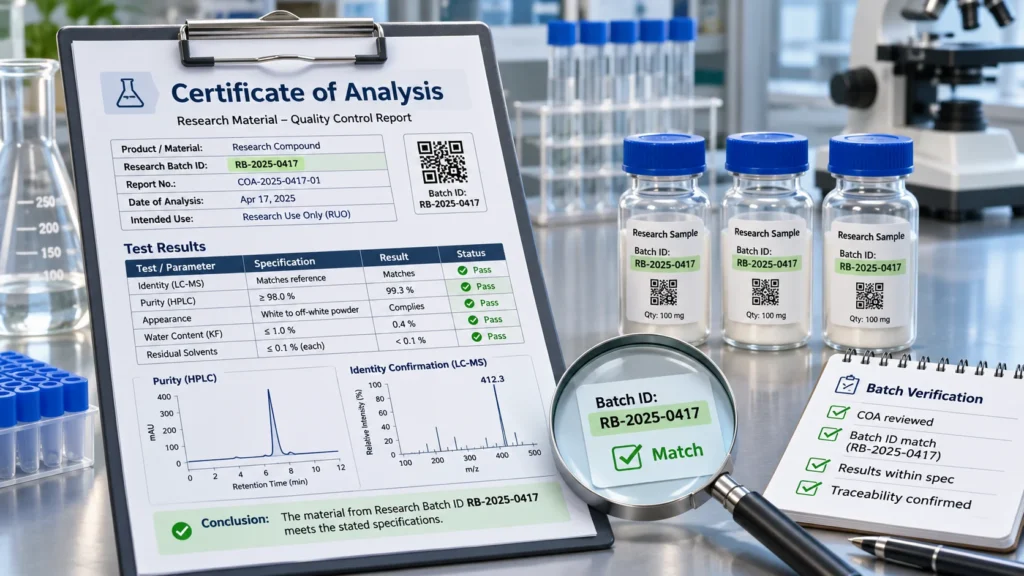
Here is a situation that happens more often than suppliers like to admit. A buyer receives a vial, finds a certificate of analysis online, sees a strong result, and files the two together. Weeks later, someone asks which batch the report actually belongs to, and nobody can say.
Certificates of analysis earn their value through a link: this document, for this sample, from this batch. Break the link and the document is a pleasant PDF. This article is about keeping the link intact, which is mostly a matter of asking a few specific questions before you order and again when the material arrives.
What “Matching” Actually Means
Matching has three layers, and each one can fail on its own.
Identity of the batch. The batch or lot number on the report is the same one tied to the product you are buying.
Identity of the format. The sample tested was in the same strength and presentation as the product, or the difference is stated openly.
Identity of the time. The report refers to the batch that is currently being supplied, not an earlier one.
Good batch documentation addresses all three. Weak documentation addresses one, usually the first, and leaves you to assume the rest.
Layer One: The Batch Number
Start with the plain identifier. Find the batch number printed on the report, then find the same number on the product record, the label, or the supplier’s batch page. They should be identical, character for character.
Be wary of reports that carry only a product name. A name tells you what was tested, not which production run it came from, and the same name can be reused across many lots.
Ask the supplier two questions: which batch is assigned to my order, and where is the report for it? A supplier with orderly records can answer both without delay. One supplier in Dubai, Remy Research, states that a report is available on request when one exists for the batch, and that before dispatch each item is matched to its batch and checked for an intact seal and label. Whatever the supplier, those are the right questions to ask.
Layer Two: The Format
A vial and a pre-filled cartridge are different presentations, and a strength tested in one is not automatically a result for another. Some suppliers test one representative sample and apply the result to related products. That is not necessarily improper, but it needs to be disclosed.
The clearest practice is a plain label. On its published peptide lab reports page, Remy Research marks each product link as either an exact format match, where the tested sample is that product’s own format, or supplier-mapped, where a batch tested in another strength or format is linked to the product. A reader can then weigh the evidence appropriately. If your supplier uses no such distinction, ask what format was actually tested.
Layer Three: Tested Batch Versus Shipping Lot
This layer is the least visible and the most often missed. A report describes the batch that went to the laboratory. By the time you order, the supplier may be shipping a later lot.
The honest wording is the one the same supplier uses on its page: each report covers the tested batch, not the current shipping lot. Treat that sentence as a standard. If a supplier claims a report covers “all stock” without naming a batch, ask what that claim rests on.
Some laboratories add their own caveat. A report may note that traceability details of the sample were not provided by the client. That means the laboratory measured what it received, and it makes no statement about where the sample came from. It is not a defect, but it is a fact to carry into your own records.
Checking the Report Against the Laboratory
Matching the batch is one task. Confirming the report is genuine is another. Laboratories use different routes:
- A task number and verification key that open the laboratory’s own copy for comparison
- A report number and signed PDF that you compare field by field, then confirm by writing to the laboratory
Whichever applies, compare the client name, sample description, batch number, results, and test date on both copies. If one field differs, or the key does not resolve, set the report aside until the supplier explains it.
A Matching Worksheet
Keep a short record for each batch you receive. It takes a minute and saves arguments later.
| Field | What to record |
| Batch number on product | As printed on the label or record |
| Batch number on report | As printed on the certificate |
| Laboratory and report/task number | For verification and contact |
| Sample format tested | Exact match or mapped, and from what |
| Analysis dates | Start and end |
| Tests run | Methods listed, including any not run |
| Verification result | Confirmed, pending, or failed |
| Date received | Your own receipt date |
Store it alongside the report and your receiving notes. Auditors, collaborators, and your future self will thank you.
What a Matched Report Still Cannot Do
Perfect matching does not widen what a report can say. A matched certificate:
- Applies only to the identified sample or batch.
- Shows purity and, where tested, the other listed parameters. Purity testing does not establish sterility or safety for human use.
- Is a laboratory document, not a regulatory approval, and it does not demonstrate compliance with UAE requirements by itself.
Responsibility for local regulations, handling requirements, and institutional research policy remains with the buyer.
Common Mistakes
Filing a report under the product name only. Without a batch number, you cannot say what it covers.
Assuming a strength-specific result applies to every strength. Check the format that was tested.
Skipping the date comparison. A report older than the current supply may describe different material.
Accepting a screenshot. Ask for the verifiable version, the PDF or the laboratory’s own page.
Letting a mismatch slide. A small discrepancy is a question to put to the supplier, not a detail to ignore.
FAQs
What should a certificate of analysis include?
A batch or lot identifier, the laboratory name, a report or task number, the sample description, test dates, the tests and methods used, and a statement of what the results apply to.
Does a certificate cover every vial of the same product?
No. It covers the identified batch or sample. Ask whether it matches the lot you will receive.
What does “supplier-mapped” mean?
It means the supplier has linked a report from a batch tested in another strength or format to a different product. It should be disclosed.
Can a report show that material is safe for human use?
No. These materials are for in-vitro laboratory research only, and purity testing does not establish sterility or safety for human use.
Conclusion
A certificate of analysis is only as useful as the connection between the paper and the material. Match the batch number, check the format, confirm the dates, and verify the report through the laboratory. Suppliers that welcome those checks, and say clearly where their evidence stops, are giving you what good documentation is supposed to deliver: a record you can trace.
These materials are supplied for in-vitro laboratory research only. Not for human or veterinary use.