Composite vs. Amalgam Fillings: Which Is Right for Your Teeth?
Introduction
Your dentist spots a small cavity on the X-ray, and then comes a question you may not have expected: silver or tooth-coloured? Plenty of adults in Dubai still carry a dark amalgam filling or two from childhood, placed years ago in another country, and they wonder whether those should stay. This guide to composite vs amalgam fillings explains what each material is made of, how long it tends to last, how much natural tooth it asks you to give up, and who it suits. By the end, you should feel ready to talk it through with your dentist instead of just nodding along.
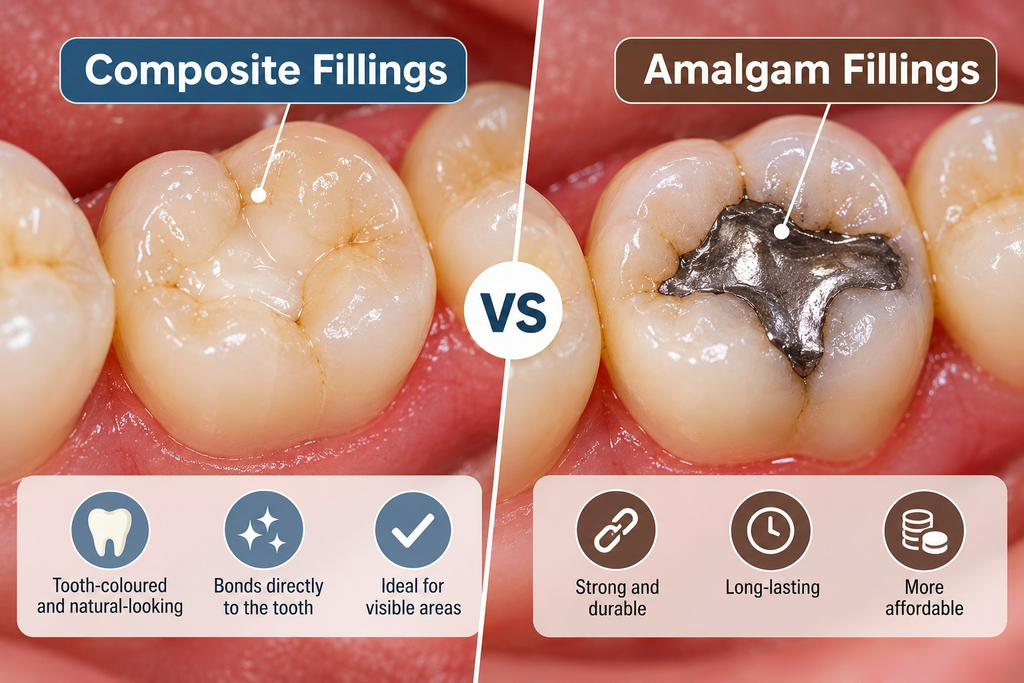
Table of Contents
- What a Filling Actually Does
- Amalgam Fillings: The Silver Option
- Composite Fillings: The Tooth-Coloured Option
- Side by Side: How the Two Compare
- Which Filling Suits Your Situation?
- What About Your Old Silver Fillings?
- Your Filling Appointment, Step by Step
- Conclusion
- Contact Us
What a Filling Actually Does
Tooth decay starts when bacteria in plaque produce acid that softens enamel. Left alone, that soft spot turns into a hole, or cavity, and moves deeper toward the nerve. During a teeth filling appointment, the dentist removes the decayed part, cleans the space and seals it with a material that rebuilds the tooth’s shape so you can chew normally again. A dental filling for cavities tends to be simpler when the decay is found early, before it reaches the nerve.
A filling stops the damage from spreading and closes the doorway bacteria were using. It does not make the tooth immune to future decay, though. The edges of any filling still need brushing and flossing like the rest of your teeth.
Amalgam Fillings: The Silver Option
Amalgam is a blend of metals: silver, tin and copper, bound together with liquid mercury. Dentists have used it for more than 150 years.
Why dentists have relied on it:
- It handles heavy chewing forces well, especially on molars.
- Placement tolerates a little moisture, which helps in hard-to-reach spots.
- The procedure is usually quick.
- Cost is often lower than for tooth-coloured materials.
The downsides:
- Colour is the obvious one. Amalgam is dark and shows when you laugh or yawn.
- This metal does not stick to the tooth. It stays in place because the dentist shapes the cavity with undercuts, which means removing some healthy tooth structure.
- Over many years, metal expands and contracts slightly with hot and cold food. In some teeth, this can contribute to small cracks.
The mercury question. Once set, the mercury in amalgam is bound into the alloy, but small amounts of vapour can be released, mostly during chewing, grinding or removal. In 2020, the US Food and Drug Administration advised that certain groups avoid new amalgam fillings where appropriate. These include pregnant women and those planning pregnancy, nursing mothers, children under six, people with kidney problems or certain neurological conditions, and anyone with a known mercury sensitivity. A global treaty, the Minamata Convention on Mercury, also asks countries to reduce amalgam use, and the European Union stopped most dental amalgam use from January 2025.
Composite Fillings: The Tooth-Coloured Option
Composite is a resin mixed with fine glass or ceramic particles. Your dentist picks a shade that blends with your natural tooth, bonds it in with an adhesive and hardens each layer with a blue curing light. A composite teeth filling can often be completed in a single visit.
What patients tend to like:
- It looks like a tooth, so most people will never notice it.
- Bonding means the dentist can often remove less healthy tooth, since the material does not rely on undercuts to stay put.
- The bond can help support the remaining tooth walls.
- There is no mercury.
What to keep in mind:
- It is technique-sensitive. The tooth must stay completely dry while the material is placed, so the appointment usually takes longer.
- Composite shrinks very slightly as it hardens. In some cases this leads to short-term sensitivity or, over time, tiny gaps at the edges.
- Edges can pick up stains from coffee, tea and karak, particularly if you sip them throughout the day.
- Very large composite fillings on back teeth, under a heavy bite, may wear or need attention sooner than amalgam would.
- Cost is usually higher than amalgam.
Side by Side: How the Two Compare
| Feature | Amalgam | Composite |
|---|---|---|
| Appearance | Silver or grey | Matched to tooth colour |
| Healthy tooth removed | Usually more | Usually less |
| How it stays in | Mechanical shape of the cavity | Bonded to the tooth |
| Moisture during placement | More tolerant | Needs a dry field |
| Appointment time | Shorter | Longer |
| Mercury | Contains mercury | None |
| Lifespan | Often many years in back teeth | Many years with good care; large back fillings may need earlier review |
| Cost | Usually lower | Usually higher |
Lifespan depends on the size of the filling, your bite, grinding habits, diet and how well you clean.
Which Filling Suits Your Situation?
Front teeth or any visible area. Composite is the natural choice because appearance matters here. The same material is also used for dental gap filling, where small spaces between front teeth are closed with bonded composite.
Small to medium cavities on back teeth. Most dentists now use composite for these. It saves tooth structure and handles normal chewing well.
Very large cavities on molars. When a big part of the tooth is gone, neither filling may be ideal. An inlay, onlay or crown can protect what remains. Some clinics design these using digital intraoral scans and CAD/CAM milling.
Heavy grinders. Constant clenching puts any filling under stress. Your dentist may suggest a night guard alongside the filling.
Pregnancy, young children or kidney concerns. Based on the FDA guidance above, composite or another mercury-free option is usually discussed.
Areas that are hard to keep dry. Cavities deep below the gumline can make bonding tricky. Here, your dentist will explain which material is more practical for that tooth.
What About Your Old Silver Fillings?
Intact amalgam fillings with no cracks, leaks or new decay underneath are usually monitored rather than replaced. The FDA does not recommend removing sound amalgam purely as a precaution, because drilling it out releases more vapour than leaving it alone and takes away extra tooth.
Replacement makes sense when a filling is cracked, the edges have broken down, decay has returned beneath it, the tooth itself is fracturing, or you would prefer a tooth-coloured look after discussing the trade-offs with your dentist. A check-up with X-rays shows which of these apply. If a new teeth filling is needed, your dentist will talk you through the material options before starting.
Your Filling Appointment, Step by Step
- Your dentist numbs the area with local anaesthetic so you stay comfortable.
- Decay is removed, and the cavity is shaped and cleaned.
- The filling material is placed. Composite is built up in layers and set with a light, while amalgam is packed in and carved.
- Your bite is checked and adjusted so the tooth does not hit first when you close.
Numbness usually wears off within a few hours. Mild sensitivity to cold or biting for a few days, sometimes a couple of weeks, is common. Composite is fully hard when you leave. With amalgam, avoid chewing hard foods on that side for about a day. If the bite still feels high, or pain is getting worse instead of better, call your dentist for a quick adjustment.
Conclusion
Composite and amalgam fillings each have a place. Amalgam is durable and forgiving to place but shows, contains mercury and needs more drilling. Composite blends in, preserves more tooth and bonds to what is left, though it takes more time and care to place. Your dentist will look at the cavity’s size and location, your bite and your health history before recommending one. Ask questions and share your priorities so you know what is in your tooth and why.
Contact Us
Our JLT clinic is easy to get to if you would like your case to be assessed in person.
Magnum Dental Clinic – JLT
Address: Shop No. 2, Indigo Tower, Cluster D, Al Thanyah Fifth, Jumeirah Lakes Towers, Dubai, United Arab Emirates.
Phone: +971 54 452 2332