How CBCT Scans and Guided Surgery Made Same-Day Dental Implants Possible
Introduction
It may seem simple to tell a patient about placing a tooth on the same day as the implant, but there is a lot of preparation involved, and most of it takes place on a computer screen before you go to the clinic.
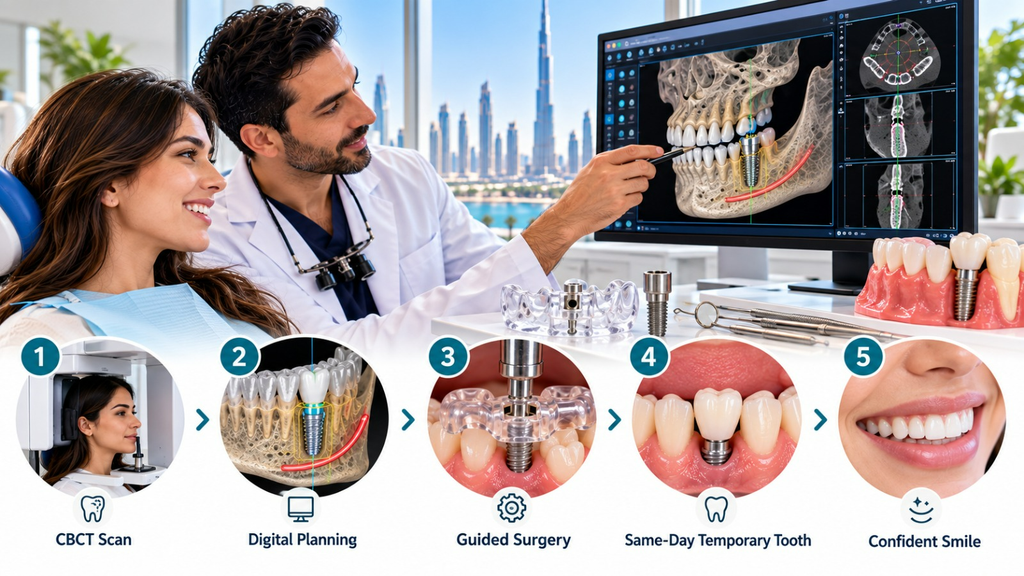
The reason why this is now possible involves two factors. The first of these is three-dimensional imaging of the jaw, referred to as a CBCT scan. The second is guided surgery, in which the plan created on the screen is transferred into the mouth using a specially made guide. Taken together, these have changed implant placement from a procedure mainly dependent on feeling to one that can be determined in advance. The following article explains how each of these methods works, using language that requires no prior knowledge of dentistry.
Table of Contents
- How implants were planned before 3D imaging
- What a CBCT scan actually is
- What the scan reveals
- The digital impression of your teeth
- Merging the files into one plan
- The surgical guide
- How this changes the day of surgery
- The questions that patients have regarding the scan.
- What technology cannot do on its own
- Conclusion
- Contact Us
How implants were planned before 3D imaging
Traditional dental X-rays are two-dimensional. They display the height of the bone and the shape of the roots, but they tell us very little about width or the shape of the ridge from front to back.
The fact that surgery was performed on the basis of flat images meant the surgeon could see and evaluate the bone directly during the operation. For many decades, skilled clinicians were able to obtain good results in this way, but it left little opportunity for planning. Whether a tooth could be attached on the same day was mostly decided at the time.
What a CBCT scan actually is
CBCT is the acronym for cone beam computed tomography; the machine rotates around your head for a short period while you remain sitting or standing, and the images it takes are then assembled to form a three-dimensional model of your jaw.
The scanning process takes less than a minute and involves neither a tunnel nor an injection. Since the radiation dose from a dental CBCT is much lower than that from a medical CT scan of the head, it has become the standard imaging procedure before implant treatment.
What the scan reveals
When the model is on the screen, your dentist will be able to cut through it in any direction and measure anything.
Useful information includes:
- Height and width of bone at the exact spot where the implant will sit
- Density of that bone, which affects how firmly an implant will grip
- Position of the nerve running through the lower jaw
- Position and health of the sinus above the upper back teeth
- Hidden infection at the tip of a root
- Angle of the neighbouring roots, which limits where an implant can be placed
If you have seen all of this in advance, you will be able to get a realistic answer as to whether same-day dental implants are suitable for your situation, rather than a hopeful one.
The digital impression of your teeth
Bone is only half the story; in order for your dentist to get the shape of your teeth and gums, an intraoral scan is required.
A small camera is moved around the mouth and creates a detailed model of the visible surfaces; patients who have memories of having full trays of impression material usually appreciate this stage since nothing has to be held in the mouth and there is no gagging.
Merging the files into one plan
The planning software combines the bone model obtained from the CBCT with the surface model from the intraoral scan, and the outcome is a single file which shows the bone, the teeth and the gums in three dimensions.
Based on the file, the dentist places a virtual implant of a particular length and width, checks to make sure there is adequate space around the nerves and the sinus, and verifies that the angle will result in a tooth that looks natural. This final consideration is easy to neglect. Although an implant can be safely positioned in the bone, it may still come up at an awkward angle for the crown, so the position is determined right from the beginning with the final tooth in view.
The temporary crown is usually arranged at this stage as well, which is why it can be ready on the day of the surgery.
The surgical guide
A surgical guide is necessary only when the plan displayed on screen can be exactly reproduced in speech.
The guide is a small specially made item, typically printed, which is placed over the teeth or gums and has metal sleeves incorporated into it. These sleeves ensure that the drills follow the precise path which had been determined earlier, thus controlling both the depth and the angle. As a result, the placement is very closely in accordance with the plan rather than depending on freehand judgement.
For patients, the advantage in practice is that the appointment becomes shorter and more predictable with less disruption to the tissue, which usually results in a smoother recovery.
How this changes the day of surgery
Once all the arrangements have been made, the appointment proceeds in a well-defined order: the area is anaesthetised, the teeth which need to be removed are taken out, the guide is put in place, and the implant is then placed through the guide.
Stability is assessed. If the fit is satisfactory, the connector and the temporary crown which had been prepared earlier are placed on and adjusted so that the tooth lies a little clear of a heavy bite; but if the fit is unsatisfactory, your dentist covers the implant and lets it heal before fitting the tooth. Although guided planning increases predictability, the bone still determines the final outcome.
Questions patients ask about the scan.
Is it uncomfortable? No injections, no enclosed space, and nothing placed in your mouth for the CBCT itself.
How long does it take? The scan takes a few seconds, with a few minutes for positioning.
Is it needed every time? For implant treatment, it is generally considered essential, since flat X-rays cannot reliably show width or nerve position.
Can I get a copy? Yes, and asking to see your scan explained on screen is a reasonable request at any clinic offering same-day teeth in Dubai.
What if I am pregnant? Tell your dentist before any imaging is taken, since non-urgent scans are normally postponed.
What technology cannot do on its own
The software can’t be used to diagnose gum disease, evaluate your bite, pick up on the fact that you clench at night, or determine whether your overall health is suitable for healing; it is still the clinical examination and the doctor’s experience that guide treatment.
A guide does not eliminate the need for careful surgical technique; instead, it reduces the room for error and ensures that the procedure can be repeated, whereas making it automatic cannot do so.
Scans also have a limited duration. Since the bone changes following an extraction, an image taken a year ago may no longer give an accurate picture of your jaw. If there is a long interval between your consultation and your surgery, your dentist will check whether a new scan is required before finalising the plan.
Conclusion
Immediate implants have become a practical option because dentists can now measure the jaw in three dimensions, plan the precise position of the implant around the final tooth, and transfer that plan into the mouth using a guide. If you are considering treatment, ask which imaging will be taken and whether guided surgery is part of the plan. Understanding what sits behind the appointment makes the process far less mysterious.
Contact Us
Ready to take the next step? Our team in Arjan is happy to help.
Magnum Dental Clinic – Arjan Address: Building 88, Al Barsha South, Near Miracle Garden, Arjan, Dubai, United Arab Emirates Phone: +971 55 890 8653