Gum Flap Infection and Wisdom Tooth Extraction: When Removal Becomes the Answer
Introduction
It usually starts as a fairly dull ache right at the back of the jaw. The next day, the gum is swollen, it’s painful to bite, and there’s a terrible taste that just won’t go away no matter how many times you brush. A lot of people just write it off as minor gum irritation. Quite frequently, though, the root cause is a small flap of gum sitting over a wisdom tooth that has only just started to erupt.
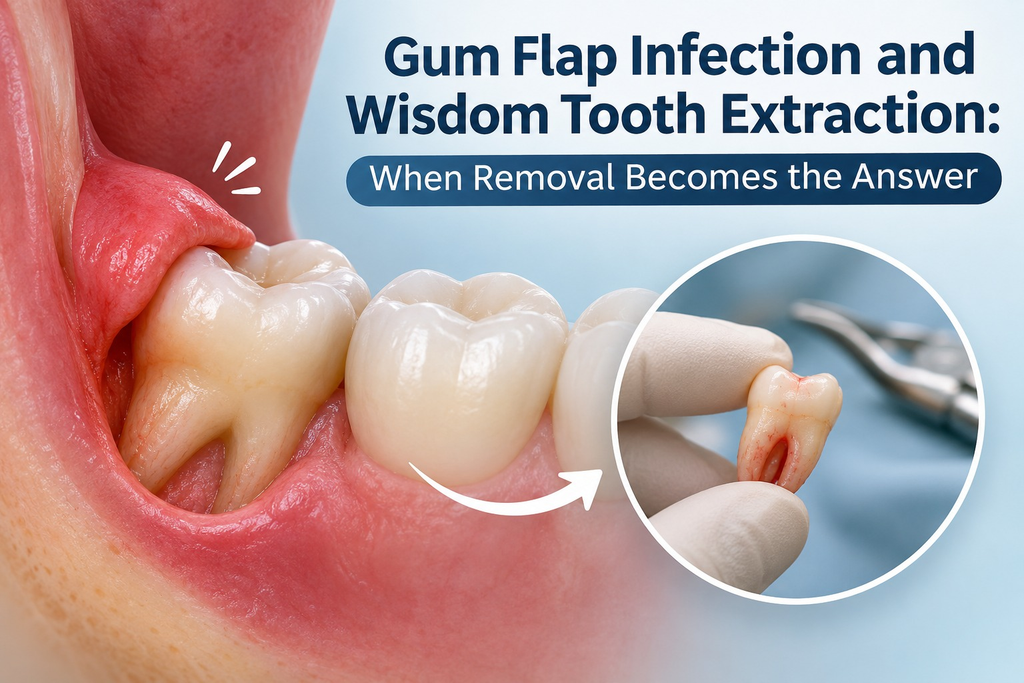
Dentists term this infection pericoronitis. A single episode is generally amenable to treatment with cleaning and home care. If it’s a recurring problem, then wisdom tooth extraction is often the solution. This article looks at why the flap gets infected, how it’s managed and how your dentist will decide when extraction is the right thing to do.
Table of Contents
- What is a gum flap infection?
- Why an Impacted Wisdom Tooth Is Usually Behind It
- Signs You Should Not Ignore
- What You Can Do Until You See a Dentist
- How Dentists Treat a Flare-Up
- When Wisdom Tooth Extraction Becomes the Answer
- What Recovery Looks Like
- Conclusion
- Contact Us
What is a gum flap infection?
A wisdom tooth will occasionally just break through partway, and a flap of gum tissue will remain draped over the top of it. That flap is known as an operculum, and below it is a small pocket which is absolutely impossible to get to with a toothbrush or floss.
Food bits and bacteria accumulate in that pocket every time you eat. Eventually the gum will react with swelling and soreness, and that’s what is known as pericoronitis in dental terms. It most frequently affects the lower wisdom teeth and is something which tends to present itself in the late teens and twenties when those teeth are trying to erupt.
Why an Impacted Wisdom Tooth Is Usually Behind It
An impacted tooth is one that hasn’t quite erupted into its normal position. It may be positioned towards the tooth in front, lying on its side, or simply not have enough space to allow it to erupt properly as the jaw comes to an end.
A tooth stuck like that will keep the gum flap in place forever. Waiting makes no difference really, as the tooth has nowhere else to go. That’s the principal reason why in some people the gum flap infections keep coming back, while in others they have one fairly mild episode and that’s the end of it.
Another factor is the upper third molar. If that’s biting down on the swollen flap, then every single meal is going to be another irritation and is going to impede healing.
Signs You Should Not Ignore
Symptoms range from mild to quite uncomfortable. Common ones include:
- Pain or tenderness behind the last molar
- Red, swollen gum over a partly visible tooth
- A bad taste or pus coming from under the gum
- Bad breath that brushing doesn’t fix.
- Difficulty opening the mouth fully or chewing comfortably
- Swollen glands under the jaw
The vast majority of flare-ups are localised. If, however, the swelling does spread to your cheek or your neck, you develop a fever, or you find it difficult to swallow, then you should get dental care the very next day. Those are the sorts of things that would indicate the infection is spreading and needs to be looked at urgently.
What You Can Do Until You See a Dentist
A few simple steps can ease discomfort while you wait for your appointment:
- Rinse gently with warm salt water after each meal.
- Use a soft brush and clean carefully around the back tooth.
- Choose soft foods and chew on the other side.
- Just take the pain relief (the over-the-counter stuff) as directed on the packet.
- Drink loads of water, particularly in the Dubai heat.
Don’t put the aspirin or any tablet directly on the gum as that will burn the gum. Home care will only help with the symptoms. The bacteria that’s trapped underneath the flap still needs to be cleaned by a professional.
How Dentists Treat a Flare-Up
The first step is to control the infection. Your dentist will usually just rinse and gently clean underneath the flap to get rid of any food and bacteria that have become trapped. Warm salt water rinses at home will help keep the area clean in the meantime.
Pain relief is usually the order of the day, and antibiotics will be prescribed if the infection has spread or you’ve got a fever. If the upper molar is actually biting into the swollen gum, then the dentist may simply smooth it down or may recommend extraction.
In some cases, a minor procedure to simply remove the flap is an option. The problem with that is that the gum can grow back over the tooth if the tooth remains partially buried. So you’ll get relief from the flare-up, but you haven’t necessarily got rid of the underlying problem.
When Wisdom Tooth Extraction Becomes the Answer
Your dentist will take an X-ray to look at the angle of the tooth, the roots and the amount of space available. Removal is usually recommended on that basis:
- The infection has come back more than once
- One was quite severe with obvious swelling and/or fever.
- The tooth has absolutely no chance of coming through properly.
- Decay has started in the wisdom tooth or the molar in front of it.
- Cleaning around the area is simply not possible.
Wisdom tooth extraction involves removing the gum pocket as well as the tooth itself, thus eliminating the gum pocket where the bacteria would have been collecting. A partially erupted tooth can be a fairly straightforward procedure. A more deeply impacted wisdom tooth may require a small surgical approach whereby the gum is opened and the tooth may be removed in pieces.
Extraction is normally scheduled once the active infection has subsided. You tend to be far more uncomfortable if you’re working on infected tissue, and it can also impede the healing process.
What Recovery Looks Like
After the extraction of a wisdom tooth, you’ll be sore for the first two or three days. The swelling will be at its worst on day two and then gradually settle. Cold packs on the cheek on the first day, soft foods and the medication your dentist has prescribed will all help.
Don’t smoke and don’t use straws for the first few days as the suction can dislodge the blood clot, which is what protects the socket. Gentle salt water rinses usually start from day two. Most people are back at work or college within a few days, although some surgical cases will take a bit longer. Your dentist will also show you how to keep the socket clean as it heals, which is particularly important at the back of the mouth where food is likely to get stuck.
Conclusion
A gum flap infection can appear to be a minor issue, but if it keeps coming back, it’s almost certainly a sign that the wisdom tooth isn’t going to sit properly. It can be managed with cleaning and medication for a period of time. If the infection is recurring or the impacted tooth has no room for healthy gum, then extraction is often the sensible long-term solution.
If you are dealing with pain at the back of your jaw, our dental team in Arjan can examine the area, take an X-ray, and talk you through what suits your situation.
Contact Us
Magnum Dental Clinic, Arjan
Building 88, Al Barsha South, Near Miracle Garden, Arjan, Dubai, United Arab Emirates
Phone: +971 55 890 8653