How 3D Imaging Is Improving Root Canal Treatment Accuracy in Modern Dental Clinics
Introduction
Imagine trying to understand the shape of a house from one photograph taken straight at the front door. You would see the windows and the roof line, but you would have no idea what sits behind the walls or how far back the garden goes. A traditional dental X-ray works in a similar way. It gives a flat view of something that has depth.
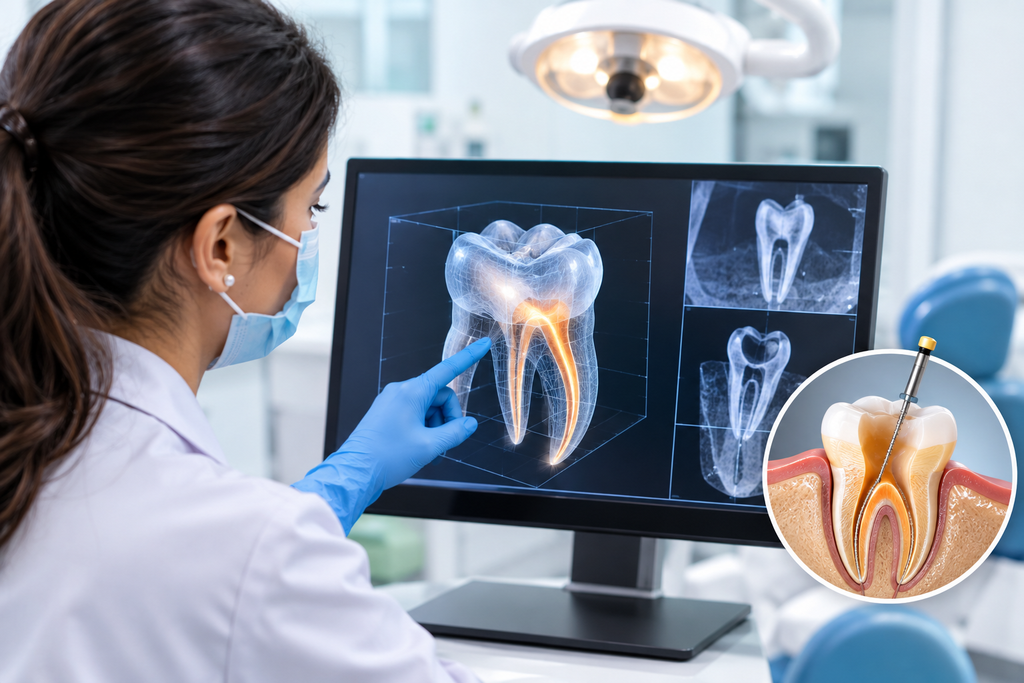
For most dental work, that flat view is enough. Root canal treatment is different, because the work happens inside narrow channels hidden within the roots, and every tooth is shaped a little differently. This is where 3D imaging, known as CBCT, has changed how many dentists plan treatment. Below, we explain what it is, how it helps, and what it means for you if you are looking for an endodontist in Dubai.
Table of Contents
- Why a Flat X-Ray Can Miss Things
- What CBCT Is, in Plain Terms
- Where 3D Imaging Helps During Root Canal Treatment
- What a CBCT Scan Feels Like for You
- Radiation: The Honest Answer
- Does Every Root Canal Need a 3D Scan?
- Conclusion
- Contact Us
Why a Flat X-Ray Can Miss Things
A standard dental X-ray squeezes three dimensions into two. Roots that sit one behind the other can overlap on the image, and a canal tucked behind another may simply not show up. Small areas of infection in the bone can also be hard to see until they grow larger.
Upper molars are a well-known example. Many of them have an extra small canal in one root that is easy to overlook on a regular X-ray. If a canal is missed and left uncleaned, bacteria can remain inside the tooth, and the infection may return months or years later.
Your dentist will still use regular X-rays. They are quick, low in radiation, and very useful. The point is that they have limits, and some cases call for more information.
What CBCT Is, in Plain Terms
CBCT stands for cone beam computed tomography. The machine rotates around your head once and captures a series of images, which software combines into a 3D model of your teeth and jaw. Your dentist can then scroll through it slice by slice and view the tooth from the front, the side, and above.
For root canal treatment, dentists usually choose a small field of view. This means the scan focuses on the area around the problem tooth rather than your whole head, which keeps the radiation dose lower.
Where 3D Imaging Helps During Root Canal Treatment
A CBCT scan gives the dentist a clearer map before treatment starts. Here is where it tends to be most useful:
- Finding hidden canals. Extra or unusually placed canals can be located before the tooth is opened.
- Mapping curved or unusual roots. Knowing the angle and length of a curved root helps the dentist plan how to clean it.
- Spotting cracks and fractures. Some root fractures don’t appear on regular X-rays, and they can change whether a tooth is worth saving.
- Measuring infection in the bone. The scan shows the size and position of an infected area more clearly than a flat image.
- Planning retreatment. When an older root canal has failed, 3D images help show what may have been missed the first time.
- Checking nearby structures. Upper back teeth sit close to the sinus, and lower back teeth sit near a nerve. Seeing those distances helps with planning.
Better information doesn’t promise a particular outcome, but it does reduce guesswork. For you, that can imply fewer surprises during treatment and a clearer explanation of what your tooth needs. Sometimes the scan also shows that a tooth cannot be saved, which spares you a procedure that was unlikely to work.
What a CBCT Scan Feels Like for You
There is nothing to feel. You stand or sit still while the machine turns around your head, which usually takes less than a minute. No injections are involved, and apart from a small bite block on some machines, nothing goes in your mouth. You will be asked to remove metal items such as earrings, glasses, and hairpins first, since metal may blur the image.
Radiation: The Honest Answer
A CBCT scan uses more radiation than a single regular dental X-ray. Compared with a medical CT scan of the head, a small dental CBCT scan uses considerably less. Dentists follow a simple principle: use the lowest dose that gives the information needed, and only scan when the result will actually help.
If you are pregnant or think you might be, tell your dentist before any imaging. You are also welcome to ask why a scan is being recommended in your case. A good clinician will be happy to explain.
Does Every Root Canal Need a 3D Scan?
No. Many straightforward cases are treated well using regular X-rays alone. Professional endodontic guidance generally recommends CBCT for selected situations rather than as a routine step for everyone. These include complex root shapes, suspected fractures, failed earlier treatment, unexplained pain, and planning surgery around the root tip.
In a city like Dubai, many patients have older dental work done in different countries, sometimes without complete records. When the history of a treated tooth is unclear, a 3D scan can fill in some of the gaps. Your endodontist in Dubai will decide based on what the examination shows.
Conclusion
3D imaging doesn’t carry out root canal treatment by itself. The skill and judgement of the dentist still do that. What CBCT adds is a much clearer view of the inside of a tooth, which helps with locating canals, spotting problems earlier, and planning treatment with fewer unknowns. Like any tool, it has trade-offs, mainly a higher radiation dose than a standard X-ray, so it is used when the benefit is clear.
At Magnum Dental Clinic, CBCT imaging is available, and a DHA-licensed endodontist can review your scan with you and explain what it shows. If you are searching for an endodontist in Dubai, ask at your consultation whether 3D imaging would add useful information for your tooth.
Contact Us
To book a consultation or ask about 3D imaging for your tooth, reach our Dubai Silicon Oasis branch.
Magnum Dental Clinic, DSO
Address: SIT Tower 101, Nr Choitram Super Market, above Baskin Robins Ice-cream, Dubai Silicon Oasis, Dubai, United Arab Emirates
Phone: +971 54 336 3340