Wisdom Tooth Extraction When Nothing Hurts: Should a Silent Wisdom Tooth Come Out?
Introduction
You’re in for a routine check-up, you’re absolutely fine, and your dentist comes back to you with the comment “your wisdom teeth may need looking at”. That’s a bit of a shock really. You’ve got absolutely no symptoms whatsoever, no pain, no swelling in any way, so why on earth would you be considering having them removed?
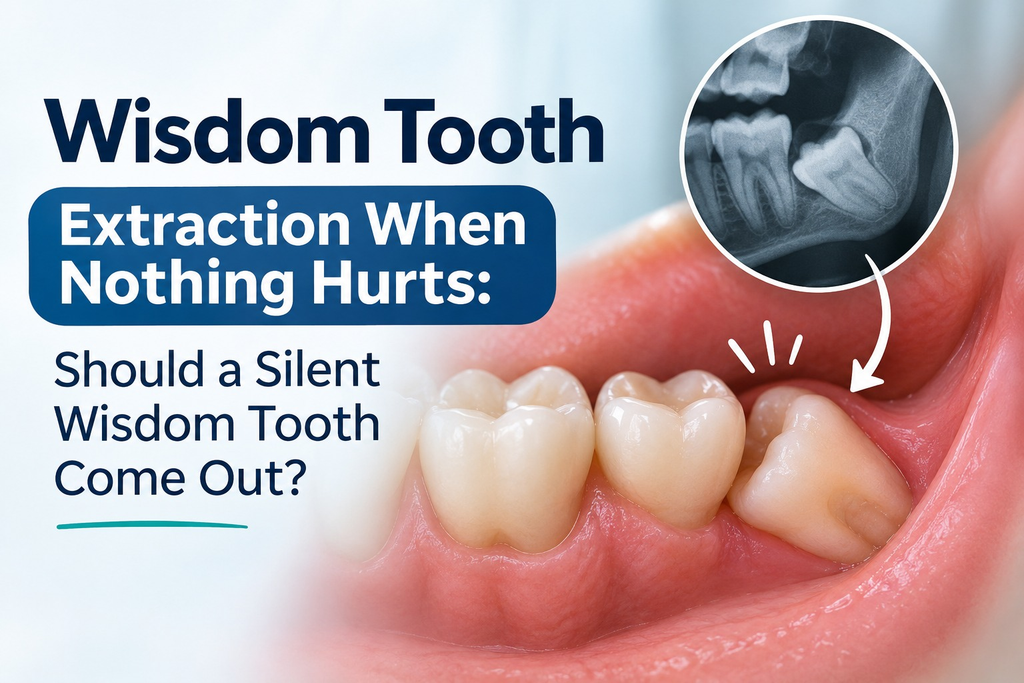
The honest answer is it depends on the tooth. Some of the silent wisdom teeth will just sit there for life without any problems at all. Others are quietly causing problems which only show up on an X-ray. This article looks at how a dentist decides whether or not to have a wisdom tooth extracted when you have absolutely no symptoms whatsoever and whether it’s actually sensible to just keep the tooth and monitor it.
Table of Contents
- Why a Tooth Without Pain Can Still Be a Concern
- What Your Dentist Looks for on an X-Ray
- Situations Where Wisdom Tooth Extraction Is Usually Suggested
- When Keeping the Tooth Is Reasonable
- Does age make a difference?
- What Wisdom Tooth Surgery Involves
- Questions Worth Asking at Your Appointment
- Conclusion
- Contact Us
Why a Tooth Without Pain Can Still Be a Concern
Pain is a very late signal in dentistry. Decay can grow for months before it gets to the nerve and gum disease will often cause you no pain at all until it’s quite far gone.
Wisdom teeth are at the very back of the mouth and it’s the bit that’s difficult to brush and floss. A tooth that’s coming through partially or that’s tilted against its neighbour will create corners where plaque can accumulate. It may not be the wisdom tooth at all that’s the problem. It could well be the second molar in front of it (a tooth you actually need for chewing) that’s the one that’s been damaged.
Problems at the back of the mouth are also likely to present themselves at the most inconvenient of times. A partially erupted wisdom tooth can remain completely asymptomatic for years and then suddenly become a problem during a busy week at work or on holiday abroad. Knowing the state of the tooth in advance allows you to plan your own schedule.
What Your Dentist Looks for on an X-Ray
A clinical check only shows what is above the gum. An X-ray reveals the rest, including:
- The angle of the tooth and whether it is impacted
- How close the roots are to the nerve in the lower jaw
- Any shadow of decay where the two back teeth meet
- Bone loss behind the second molar
- A fluid-filled sac or cyst around a buried tooth, which is uncommon but possible
In some instances a 3D scan (a CBCT) is used to get a much clearer view of the tooth and the nerve prior to any decision being made. All of this information together enables the dentist to properly assess whether a tooth can be retained or is likely to be a problem.
Situations Where Wisdom Tooth Extraction Is Usually Suggested
Even without symptoms, removal may be recommended if:
- Decay has started in the wisdom tooth or the molar adjacent to it.
- Food keeps getting caught and the area simply can’t be cleaned.
- Gum pockets around the tooth are getting deeper over time.
- A cyst or other lesion is seen on the X-ray.
- An upper wisdom tooth has no opposing tooth and is drifting down.
- You’re planning on doing some other dental work (e.g. braces, a bridge etc) and the position of the tooth is going to affect that.
Your dentist should be able to tell you which of those applies to you. Removal is a sensible thing to do if there’s a clear reason for it rather than just because the tooth is there.
When Keeping the Tooth Is Reasonable
Many wisdom teeth do not need to come out. Keeping the tooth is often a sensible choice when:
- It’s come through completely and is in line with your bite.
- You can clean it quite well and the gums around it are fine.
- It’s buried right in the bone with no sign of disease at all.
- The roots are right up against the nerve and the risk of surgery is greater than the benefit.
Keeping a tooth doesn’t mean you’re just going to forget about it. Dentists will normally keep a watchful eye on a silent wisdom tooth with regular reviews and periodic X-rays so any change can be detected early on.
Does age make a difference?
Age does make a difference in terms of planning. In the late teens and early 20s the roots of the wisdom teeth are often not fully formed and the bone around them is softer. It’s generally a far simpler job to remove them at this stage and recovery is much quicker.
As we get older the roots grow longer and the bone becomes denser. Wisdom tooth extraction is still a very common procedure in adults, though the recovery will be a bit longer. That’s one of the reasons that dentists will sometimes talk about the prospect of removing a tooth earlier on if it’s likely to cause problems later. Age in itself shouldn’t be the sole reason for removing a tooth that is otherwise healthy. Your general health, the medications you’re on and the position of the tooth are all equally important.
What Wisdom Tooth Surgery Involves
The word ‘surgery’ sounds like a far bigger operation than it actually is. For a buried or angled tooth you’ll typically have the dentist make a small incision in the gum, may remove a bit of bone and in some cases will divide the tooth into pieces so it comes out more easily. The area is completely numbed so you should just feel pressure rather than any sharp pain.
The majority will have some swelling and soreness for a couple of days. Stitches will either be absorbable (dissolve on their own) or be removed at a subsequent visit. Recovery will typically involve soft foods, cold packs on day one and then just taking it easy for a couple of days. Your dentist will of course go through the possible complications (dry socket being the most common, and very rarely temporary numbness of the lip or tongue) so you can make an informed decision.
Questions Worth Asking at Your Appointment
If your dentist suggests removing a wisdom tooth that is not bothering you, these questions can help:
- What did the X-ray actually show?
- If I just leave the tooth alone, what the hell could happen?
- Is this a simple extraction or a wisdom tooth surgery?
- How long should you plan for recovery?
- Can we monitor it instead and how frequently?
Clear answers will help you feel confident in whatever decision you end up making.
Conclusion
A non-painful wisdom tooth is not necessarily a problem and is not necessarily a harmless thing. It all comes down to what the X-ray shows, how well you can clean the area and your general dental health. In some instances the extraction of a wisdom tooth will actually prevent a bigger problem with the adjacent teeth. In other cases you can simply monitor it.
If you’ve been advised that your third molars need looking at (or indeed you just want them checked), our DSO dental team can have a look at your X-rays and give you a clear explanation of your options.
Contact Us
Magnum Dental Clinic, DSO
SIT Tower 101, Nr Choitram Super Market, above Baskin Robins Ice-cream, Dubai Silicon Oasis, Dubai, United Arab Emirates
Phone: +971 54 336 3340