Upper vs Lower Wisdom Tooth Extraction: Why the Experience Can Differ
Introduction
Two friends have their wisdom teeth out in the same week. One is back to normal meals in a couple of days, while the other spends nearly a week with a swollen cheek and a stiff jaw. Neither of them did anything wrong. Very often, the difference comes down to which wisdom teeth were removed.
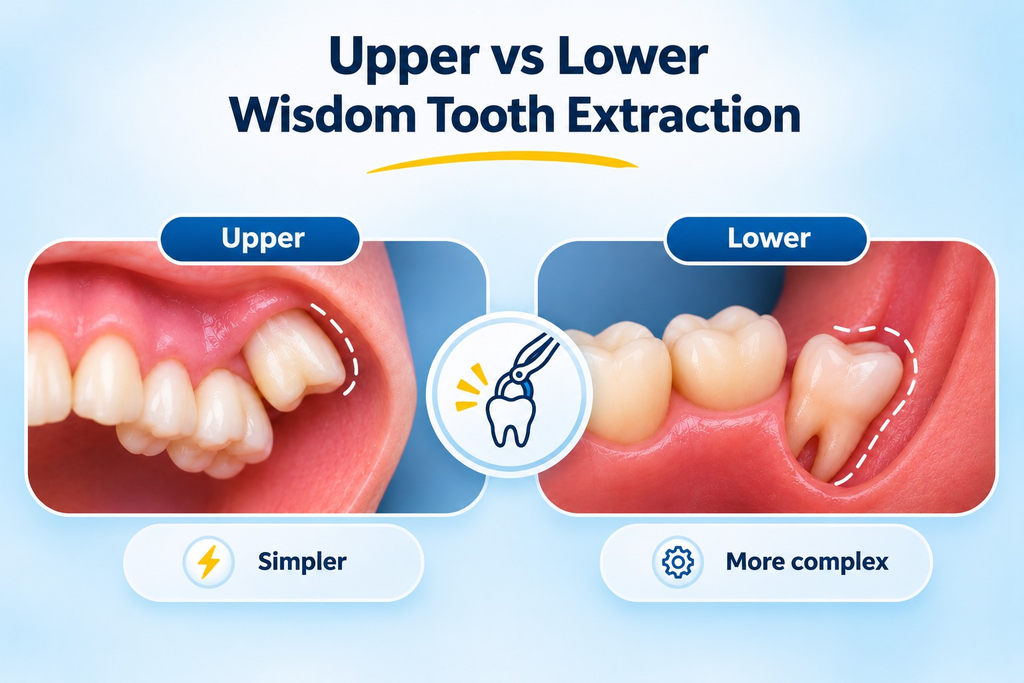
Upper and lower wisdom teeth sit in very different kinds of bone, close to different structures, and are positioned in different ways. Those details shape how the extraction is done and how recovery feels. Understanding them helps you know what to expect from your own wisdom tooth extraction and ask better questions before the day.
Table of Contents
- How Upper and Lower Wisdom Teeth Differ
- Why Lower Wisdom Teeth Are Often More Complex
- What Makes Upper Wisdom Teeth Different
- How Numbing Feels in Each Jaw
- Recovery After Upper vs Lower Wisdom Tooth Extraction
- Aftercare That Applies to Both Jaws
- Removing Upper and Lower Teeth Together
- Conclusion
- Contact Us
How Upper and Lower Wisdom Teeth Differ
The upper jaw is made of lighter, more porous bone. By contrast, the lower jaw is thick and dense, built to handle the force of chewing. That one difference already explains a lot.
Upper wisdom teeth often grow down and slightly outward towards the cheek, and many come through without much trouble. Lower wisdom teeth are more likely to be trapped against the molar in front or held under the gum and bone. In other words, impacted teeth are far more common in the lower jaw.
Position in the mouth matters as well. Upper wisdom teeth are usually easier for the dentist to see and reach, while lower ones are often partly hidden by the cheek and tongue.
Why Lower Wisdom Teeth Are Often More Complex
Dense bone holds a tooth firmly, so removing a lower wisdom tooth usually takes more effort. If the tooth is tilted or partly buried, the dentist may need to open the gum, remove a small amount of bone, or divide the tooth into sections. This type of wisdom teeth removal is what people usually mean when they talk about surgical extraction.
The lower jaw also contains a nerve that supplies feeling to the lower lip, chin and part of the tongue. Lower wisdom tooth roots sometimes sit very close to it. Before the procedure, your dentist checks this on an X-ray, and a 3D scan may be suggested if the roots and nerve look close together. Tingling or numbness after lower extractions is uncommon, and in most cases it settles over time.
What Makes Upper Wisdom Teeth Different
Upper wisdom teeth are generally easier to reach and lift out, because the bone around them is softer. Many are removed in a relatively short appointment, with less swelling afterwards.
Sometimes an upper wisdom tooth is removed even when it looks healthy, because the lower tooth beneath it has already been taken out. Without a partner to bite against, the upper tooth can slowly drift downward and start rubbing the gum or cheek.
There is one thing specific to the upper jaw. The roots of upper back teeth can sit very close to the maxillary sinus, the air space above your upper teeth. Occasionally, removing the tooth leaves a small opening into the sinus. Your dentist will look for this and may give you simple instructions for a short period, such as:
- Avoid blowing your nose forcefully.
- Sneeze with your mouth open
- Skip swimming and flying for a while if advised.
Small openings like this usually heal on their own with care.
How Numbing Feels in Each Jaw
The way your mouth is numbed also differs. For upper wisdom teeth, the anaesthetic is usually placed in the gum next to the tooth, and the numbness stays fairly local.
Lower teeth are numbed with what is called a nerve block. Here, the injection is placed further back to numb the whole side of the lower jaw. Expect half of your lower lip, chin and tongue to feel numb for a few hours. Be careful not to bite your lip or tongue, and wait until feeling returns before eating anything hot.
Recovery After Upper vs Lower Wisdom Tooth Extraction
| Upper wisdom tooth | Lower wisdom tooth | |
|---|---|---|
| Swelling | Usually mild | Often more noticeable, peaking around day 2 to 3 |
| Jaw stiffness | Less common | Fairly common for a few days |
| Dry socket risk | Lower | Higher |
| Food trapping in the socket | Less likely | More likely, as food settles into the lower socket |
| Return to normal eating | Often within a few days | May take around a week, longer after surgical removal |
Your dentist may give you a small syringe to rinse the socket gently after lower wisdom tooth extraction, usually once the first few days have passed. Keep in mind that this table describes general patterns. A straightforward lower extraction can heal faster than a difficult upper one.
Aftercare That Applies to Both Jaws
Whichever teeth are taken out, wisdom teeth removal in either jaw follows similar rules in the first few days:
- Bite gently on the gauze for as long as your dentist advises
- Use cold packs on the cheek during the first day.
- Eat soft, lukewarm foods and chew away from the area.
- Begin warm salt water rinses from the second day, unless told otherwise.
- Avoid smoking, shisha and drinking through straws
- Sleep with your head slightly raised for the first couple of nights.
Call your dentist if bleeding does not slow down, pain gets worse after day three, or you notice a fever.
Removing Upper and Lower Teeth Together
Many people have both upper and lower wisdom teeth removed on the same side, or all four at once. Doing them together means one recovery period instead of several. On the other hand, having both sides treated at the same time makes chewing harder for a few days.
When planning wisdom tooth removal in Dubai, your dentist will look at the position of each tooth, your general health and your schedule before recommending a plan. When deeply impacted lower teeth are involved, they often set the pace of your recovery, so plan your time around them.
Conclusion
Upper and lower wisdom teeth may share a name, but the experience of removing them can be quite different. Lower teeth are more often impacted, sit in denser bone and lie close to a nerve, so they usually need more deliberate planning and a slightly longer recovery. Upper teeth tend to come out more easily, with the sinus being the main thing to watch.
Knowing which teeth you are having removed helps you prepare properly for your wisdom tooth extraction. If you would like your wisdom teeth assessed, our team at the JLT clinic can review your X-rays and explain what your treatment and recovery may look like.
Contact Us
Magnum Dental Clinic – JLT
Address: Shop No. 2, Indigo Tower, Cluster D, Al Thanyah Fifth, Jumeirah Lakes Towers, Dubai, United Arab Emirates
Phone: +971 54 452 2332